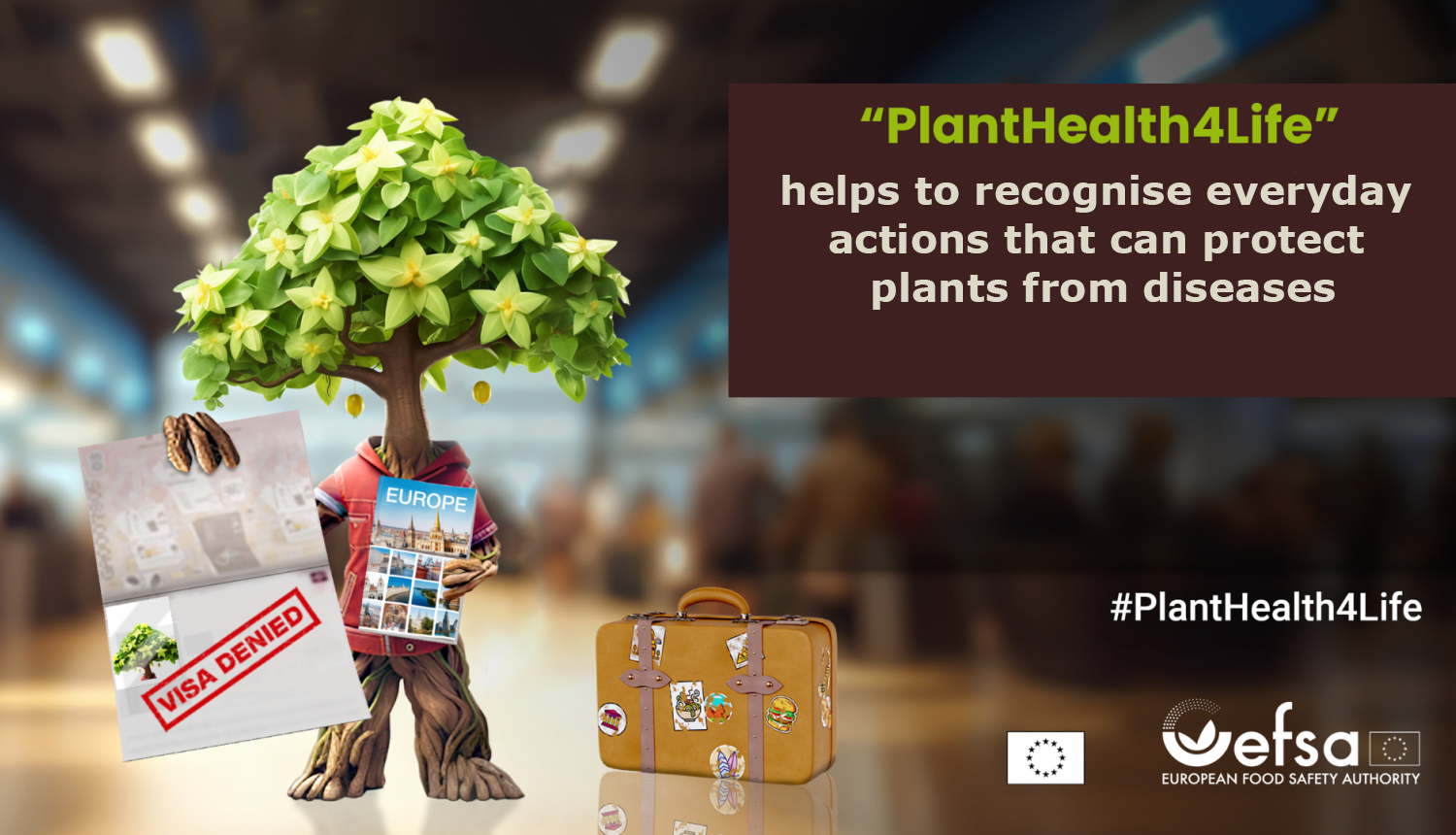
EFSA campaign visual featuring an animated plant standing next to a suitcase and holding a rejected visa application in its hands.
FacebookX / TwitterLinkedinThreads

“PlantHealth4Life” helps to recognise everyday actions that can protect  plants from diseases

In the fourth and final year of the “PlantHealth4Life” campaign, the European Food Safety Authority, the European Commission and 33 countries will continue working towards the common goal of making care for plant health an integral part of our daily lives.

Since the start of the campaign, the main focus has been on how closely plant health issues are linked to everyday life — not only from the perspective of food or gardening, but also in relation to travel and shopping.

In its final year, the “PlantHealth4Life” campaign continues what it has started, encouraging people across Europe to follow the latest information, share it and apply it in their daily lives, so that with very little effort they can help protect plants, the environment and many sectors of the economy.

“‘PlantHealth4Life’ is based on the fundamental principle that awareness leads to action. In this final year, the campaign shows even more clearly how, by protecting plant health, we protect our food, our environment and our future. By involving people across Europe, the campaign has laid strong foundations that will continue to support plant protection efforts long after the campaign has ended,” says Sylvain Giraud, Head of the Plant Health Unit at the European Commission’s Directorate-General for Health and Food Safety.

“Science helps us understand threats to plant health, but that alone is not enough — Europeans need to connect this knowledge with their everyday lives. ‘PlantHealth4Life’ makes the term ‘plant health’ understandable and gives it meaning. By travelling responsibly, shopping responsibly and educating the next generation, we can all contribute to addressing this challenge,” explains Tobin Robinson, Head of the Environment, Plants and Ecotoxicology Unit at the European Food Safety Authority.

“By launching the campaign during the Cyprus Presidency together with leading plant health specialists from across Europe, we are clearly showing that plant health is a responsibility shared by the whole of European society. The right everyday choices made by citizens, combined with close cooperation between countries, help protect our plants and our future,” says Anthemis Melifronidou, Chief Plant Health Officer of Cyprus.

By showing that plant health concerns us all, the “PlantHealth4Life” campaign promotes awareness and strengthens a shared sense of long-term responsibility.

Tell Others and Get Involved!

The actions of every European citizen play an important role in maintaining a high level of plant health. Visit the #PlantHealth4Life campaign website and learn how the campaign encourages the public to protect plants from the introduction of diseases that are difficult to control. A variety of resources are available there, including press materials, social media posts and videos.

Anyone interested can take part in the campaign, but it is particularly aimed at:

  • curious travellers, who enjoy discovering the world and nature in different places;
  • gardeners, who grow and care for vegetables, flowers and trees at home;
  • parents, who care about the food their children eat and who want to preserve a pleasant environment and natural biodiversity for future generations.

About the campaign

#PlantHealth4Life is a multi-year campaign developed at the request of the European Commission. It is based on an in-depth analysis of how residents of the European Union understand plant health and how they act in this area.

The campaign has expanded its scope and increased its audience, and now covers 33 countries:

  • European Union Member States — Austria, Belgium, Bulgaria, Croatia, Cyprus, Czechia, Denmark, Estonia, Finland, France, Germany, Greece, Hungary, Ireland, Italy, Latvia, Lithuania, Luxembourg, Malta, the Netherlands, Poland, Portugal, Romania, Slovakia, Slovenia, Spain and Sweden;
  • candidate countries and potential candidate countries — Albania, Bosnia and Herzegovina, Kosovo*, Montenegro and Türkiye;
  • Switzerland.

*this designation is without prejudice to positions on status, and is in line with United Nations Security Council Resolution 1244/1999 and the International Court of Justice Opinion on the Kosovo declaration of independence.

How Plant Health Affects Our Lives

Plants make up 80% of the food we eat, they are used to feed the animals raised for food, and they clean the air we breathe. But that is not all — healthy plants ensure high agricultural yields, which in turn affects food availability and food prices for consumers. Learn more about the importance of plants!

Climate change and human activities, such as trade and travel, unintentionally expose local plants to significant risks. The spread of plant pests and diseases can have devastating effects on the economy and the environment.

For example, the pine wood nematode is a microscopic worm that bores into wood and can rapidly destroy pine trees and devastate forests. Until 1999, this nematode had not been detected in the European Union. It first became established in Portugal, but is now also found in some regions of Spain and has recently been detected in France.

To stop the spread of the nematode, European Union rules require all susceptible trees — pines, spruces and some other conifers — within a 500-metre radius of the infested tree to be cut down and destroyed. This has a major economic and environmental impact, especially in regions with extensive pine and spruce forests.